Showing posts with label faith. Show all posts

Wednesday, December 11, 2013

Breaking Traditions


On the last night of the Soulation Gold Gathering in September, Jonalyn did a fascinating presentation on different Christian faith traditions. She talked about the contemplative tradition, the charismatic... the evangelical. For the first time, it thoroughly hit me that evangelicalism, the tradition that has dominated my life, is a channel within Christianity and not Christianity itself. It's a way to know and experience Christ, not the only way. The implications of this continue to unfold in my life, and I have to say, I feel freer.

Evangelicalism is characterized by a focus on Scripture - working to understand it and interpreting all of life through its lens. In keeping with that world, the denomination I'm part of is very academic. The Bible is studied and analyzed intensely. As a scholarly person, I was majorly drawn in by this approach and dug in happily for over a decade. But over the last couple of years, my ESV Study Bible with its endless footnotes has gotten heavy. My individual Bible study has dwindled. When I started losing interest, I buckled down and bought books, books with study outlines and questions for reflection, expecting them to solve my "problem." They sit in a dusty pile on my nightstand, barely written in.

In my hundredth attempt to get  back "on track," I signed up for another YouVersion plan - chapters delivered to my inbox five days a week. I went to the preferences page to switch the version to ESV as usual. But as I scrolled down the list of options, I hesitated over one. The translation I've raised my eyebrow at for my entire adult life. The modern-language favorite of hipsters, emergents, and greeting card writers: The Message.

I decided that if The Message couldn't make the Bible feel fresh again, nothing could, and I selected it before I could change my mind. So here's my confession: for the past month, I've been reading the New Testament in The Message... and loving it. Paul and Timothy and the gang seem like real people. I can clearly picture the events described. I'm comprehending things I never have before because they're in plain English. I'm experiencing a story, not dissecting a textbook. Maybe every word isn't precisely translated from the Greek, but it feels refreshingly real, and that's what my worn-out soul needs right now.

I've had a chokehold on my faith for a long time, and this is one way that I'm finally letting it breathe a little. At times I've even been afraid for my salvation because I'm growing and questioning and don't believe or behave exactly as I used to. But I maintain that a messy but alive faith is healthier than a solid but stagnant one. I'd rather grow to be an oak tree, though it can be scary and uncomfortable, than to stay locked up in my safe acorn in the ground.

Friday, November 22, 2013

Four Novembers


I thought it might be time to tell the full story of November 2009, the month that changed my everything forever. I've never talked much about the details, but I have enough distance from it now to know that it's a soap-opera-worthy story. When I recounted that month to my counselor, whom I've only been seeing for a short time, her mouth dropped open further and further.

My husband told me he had had an affair… with a college-aged girl. I wanted to save the marriage. He changed his mind about whether to stay or go on an hourly basis. We celebrated his birthday anyway. Then he packed up and left me while I was at work. Oh and did I mention my sister was also getting married… in another state? I was the maid of honor. And my parents didn't know what was going on until the week of the wedding. And the day before we left for the wedding, he decided he wanted to come home and try again.

Yeah, that's the short version.

This week, I sat down and started purging my clearest memories onto the screen. I thought I'd get it all out for my own catharsis, then maybe try to polish it for the public. Only a few minutes in, I had to look at my journal entries from that time to refresh my memory. Usually, that exercise is pretty painful. But this time, what I noticed most was how clear and strong I sounded. Reading my own words was like witnessing my own rebirth. It showed me I could stand to take a few lessons from my past self.

Sometimes I forget what it was like to realize, for the very first time, that I had a divine right to stand up for myself. Don't get me wrong – I was a complete mess at the time. I couldn't eat and I was fending off panic attacks. But at the same time, there was a peace and strength I'd never experienced, and I knew it was from God. Even in the darkest moments, I felt like a blinding beam of light was radiating out of me, a light that wasn't from me. I felt like Galadriel, blazing beautiful and terrible. That sounds crazy, but I can't describe it any other way.

All my life, I'd let people take advantage of me, in the name of considering others more important than myself. Even those who should have been looking out for my best interests took me up on that offer. All my marriage, I'd put my husband first, swallowing my own hurts. Submitting and then submitting some more. Wondering why all my submitting wasn't paying back love like the marriage books promised it would. But now something holy had been breached, and I was more certain than I'd ever been of anything that God was not okay with it. Any of it. He was angry about what was happening to His daughter, and He was letting me know that I didn't have to lay myself down on those train tracks anymore. I could draw a line – between myself and my husband, my family, the universe. I could have my own back. I could say, No more. Never again. This far and no further. I still took my husband back, but I took him back as a woman who knew her own worth, who would not be disregarded or pushed aside. That's probably why, six months later, he decided he didn't want to stay married after all.

The other thing that stood out in my memory, in my journal entries, was how well my friends loved me during that time. To this day, I feel a special bond with the friends I invited into my worst mess. They were amazing – spending the night with me, bringing me food, sending me flowers and buying me shoes. Praying hard. Gathering intel. Threatening lives. (They were kidding. I think.) They were the hands and feet of God to me.

I remembered all this. Then I closed the computer and went to bed, not feeling sad, but peaceful and thankful. Thankful for my loved ones, who were there when I needed them most, even if we don't talk every day now. Thankful to be me, to be whole. Thankful for God's love and protection.

It's been four years, and it occurred to me that four years is like high school. I was a "freshman" when it happened, and now I'm a "senior." Maybe someday I will tell my whole story. Maybe even in a book. But right now, I'm ready to graduate.

Thursday, November 7, 2013

Guest Post: The God Who Hears


I met Jamie, blogger at Ava Anomaly, in my Story 101 class this summer. We were paired up for a peer critique and hit it off right away! When she announced a guest posting opportunity to write from the perspective of Biblical people, I knew I wanted to participate, and I knew who my subject would be: Hannah, the mother of Samuel. Hannah has been one of my favorite Biblical people since I was a teenager. I'm pretty sure I had her song, from I Samuel 2, up on the wall of my college dorm room. I never imagined back then how much we would have in common. Writing about her was cathartic (and also made me want to write about her rival wife, Peninnah, who surely had hurts and struggles of her own).

All that to say, please head over to Jamie's to read my Empathy piece about Hannah, "The God Who Hears." Thanks!


Saturday, October 12, 2013

Resting and Being


My biggest takeaways from the Soulation Gold Gathering weren't the things I would have expected. Exhibit A: the importance of Sabbath. Sadly, it's been years since I consistently practiced any concept of Sabbath - my awareness of this lack was heightened before I even went to the Gathering. I know that rest is a COMMAND, which I ignore to my own detriment. But if I take a whole day to rest and/or do whatever I want, it's just not possible to get everything done. And I don't have enough hours in the other six days to work extra hard to free up the time. For me, the stress of that would negate the day of rest anyway.

But thinking about this, and experiencing the rest and refreshment I had in Colorado, cast the craziness of my everyday life into alarming relief. As I've mentioned before, for several months (and really for most of my adult life), I've been operating on adrenaline. There's no time for being, only for doing. I am addicted to doing, and the pressure to do constantly is tremendous. My journey with busyness has been somewhat like what many people experience with antidepressants. I reach an unhealthy place where I have to quit some activity for my own sanity. So I do. Then, before long, I'm presented with an attractive new opportunity. Because I feel so much better due to the increased free time, I think, "Yes, I can and should do this!" and happily sign up, and the cycle starts again. Soon I'm back in this maxed-out place wondering how I got here. I'm embarrassed at how many times this has happened.

2013 has been my year of learning to own my identity as a writer. So I'm newly aware that the frantic brain and the creative brain are diametrically opposed. I cannot create if I never stop rushing from one activity to the next. It's a smaller vicious cycle nested inside the first one - I'm overstressed, I can't think to write, then I feel more stressed because writing is how I process life. In a similar vein, when I'm too busy, I can't "hear" God. All the noise drowns Him out. Then I feel disconnected from Him, which makes everything else worse. To fulfill my calling and be fully human, I have to give my mind, heart, and soul more room to breathe. Taking time to rest is not selfishness. It's what enables me to do the important things.

So I'm starting small. I'm thinking a lot about how I can create pockets of rest in my life, more time to write and relax and be. I'll have to lay down some of my pride - in taking care of my lawn all by myself, in not being seen as undependable or a quitter. But more than a lesson in humility, this is a lesson in trust. I listen so readily to the voices of fear, to those who tell me I have to do more and more and more in order to find a man. In the quiet of the mountains, I felt God asking me, Hey, do you think you can trust Me with this? I didn't realize until that moment that, successfully spooked by "God won't bring the right man to your door," I'd gone to the opposite extreme.

It won't be easy, but it's time (again) to stop striving. It's time (again) to remember who's in charge of the universe, and stop feeling like I'm solely responsible to make everything happen. He's got this, and I need to quiet myself enough to listen for His voice and for the words He's given me. I need to lay in the sunshine and let it do its life-giving work on the seeds in my soul.

Saturday, October 5, 2013

Soulation Gold Gathering

Untitled


A couple of years ago, my friend Hillary and I were having one of our many conversations about Christian Women's Issues. She suggested I read Ruby Slippers by Jonalyn Fincher. Hillary's brother-in-law was (and still is) a staff writer for Soulation, the ministry Jonalyn runs with her husband Dale, and she had met her when she came to town for a speaking engagement. So I read Ruby Slippers, loved it, and started recommending it to other women. From there I got hooked on Soulation's blogs and was taken in by the ministry's honesty, depth, fresh perspective, and focus on "being fully human." I appreciated that the Finchers weren't afraid to wrestle with big, difficult questions.

Soulation holds small retreats - Gatherings - three times a year in Steamboat Springs, Colorado, where Dale and Jonalyn live. Each Gathering focuses on a different topic. After my friend Esther attended the White Gathering last winter, I wanted to go too. But due to cost and personal insecurity, I didn't expect to do so anytime soon.

At the beginning of August, I got an e-mail from Soulation saying that two people had canceled for the Gold Gathering at the end of September. If they couldn't fill the spots by that Friday, they would have to cancel the whole thing. The theme was What Is The Church? Since I've spent the last few years increasingly pondering how to find my place in the Church, my antennae went right up. I texted Esther, I'm considering applying. What do you think? I talked to a few friends. I called my dad. The response was unanimous. Despite the expense, and the potential craziness of crossing the country to hang with a bunch of total strangers, everyone encouraged me to go for it. I hurriedly applied that night and was accepted by the weekend. As my mom likes to say, it was clearly a God Thing.

I wasn't sure what to expect from the Gathering. I hoped to be refreshed, feel closer to God, get some new insights, and enjoy nature. I got all of that in spades. Our group was made up of twelve people (counting the Finchers), all Christians but from different backgrounds and in different spiritual and life places. Many attendees were struggling with legitimate church-related issues a lot bigger than mine. Normally it would take days of small talk to reach deep topics with new people, but our group dove right into it. I loved that. Of course we got to know each other at a more surface level too, but it was great to feel like we had a common mission. Each day we had a presentation and at least one "official" discussion time, but there were plenty of free hours to hike, bike, explore the area, or just have down time at the gorgeous chalet where we were staying.


Untitled


I'd been to Colorado twice before - once to ski when I was in high school (it wasn't as fun as it sounds), and once en route from the Denver airport to visit my ex's grandparents in southeastern Wyoming. But I'd never experienced Colorado. Just being there was invigorating for my body and soul. The changing trees, the unexpected snow, the rivers, the fresh air. To my own surprise, I pretty much fell in love with the place.


Untitled
Photo by Dale

What most drew me to this particular Gathering was my feeling of isolation within the Church. I think other regions of the country, and other Christian groups, are more integrational (is that a word?). But in a conservative denomination in the South, as a single (divorced!), childless 30something, I'm perpetually out of place. Even though I don't believe one's marital or parental status should be the core of one's identity, the fact remains that the American Church in my neck of the woods is designed for families. There's no proactive path laid out, no mentors for someone like me. Rather than get bitter and complainy about it, I try my best to do positive things with that frustration, to blaze a trail for myself and for those who will come after me. But it's often lonely and sad.

I hoped to find some answers about that at the Gathering. If I did, they haven't fully formed yet. But I learned many valuable things that will stay with me. I was reminded that my neck of the woods is just one small section of the giant forest that is the Body of Christ. I saw the presence of God in other Christians who are different from me, and heard their stories. I felt, in the best possible way, that many of the spiritual and churchy things I worry about aren't such a big deal. That maybe I can give myself and others a break sometimes. Honestly, I think it may take months to fully process my thoughts and feelings.

I'll never forget my fellow Gatherers. We climbed mountains. Literally and figuratively.


Untitled
Photo by Rob

Wednesday, September 11, 2013

My History of Silence

sea urchins in the sky


I've spent most of my life apologizing for my opinions, but I'm currently experiencing a lot of opportunities and encouragement to use my voice boldly. Over the past five or six years, I've learned to own my thoughts and feelings on just about everything, and now I'm learning to express them appropriately. It's even more difficult than I thought it would be.

In my former life as a diehard people-pleaser, it was hard to object to anything about me because I didn't give people much to object to. I toned down my personality. I kept disagreements to myself or vented to a select few. I avoided conflict at all costs. I always tried to think of myself (and therefore my opinions) as much less important than others, because isn't that what the Bible teaches? On top of that, as a woman I was supposed to take a backseat to men, so there wasn't much point in getting too passionate about anything.

You can imagine how this played out in my marriage. Since the main advice to Christian wives in difficult marriages is to submit more – aside: a post on that topic is on a slow boil within me – I doggedly pursued the elusive, magical degree of submissiveness that would make things right, make a husband love his wife like Christ loved the church. Spoiler alert: it doesn't exist, and I almost lost myself trying to reach it. But when I hit rock bottom, the Holy Spirit was there. He showed me that I had inherent worth and value, that I wasn't created to be an empty vessel, existing only to be filled with whatever pleased my spouse, family, church, or employer. No, God made me, on purpose, as a whole individual with preferences and feelings and rights. I had dignity because He created me, myself, in His image. This epiphany was my rebirth. I started saying no to people who were taking advantage of my yes. I started setting boundaries and dreaming dreams. I started standing up to my husband, pointing out legitimate needs that had gone unmet for years. He didn't behave any differently, but my confidence increased as I climbed, hand over hand, out of the pit of being everyone's doormat. Because of that sacred time in my life, when my ex finished wiping his feet all over me and walked out, I was secure enough – in God and in myself – to let him go. No matter what anyone thought, I knew I had fought the good fight and kept the faith. That his choices were his own responsibility, not mine.

That was the beginning.

In many ways, after my divorce, I had to learn who I was all over again. I had to give myself permission to swing too far the other way, trusting that God would catch me in the middle. The same is true about speaking up. I have to risk overdoing it sometimes to drown out my programming. I just concluded two years with a wonderful Wednesday night small group, full of honest, fun, flawed people like me. Even within that safe community, I went home many Wednesday nights thinking, I talked too much (i.e. maybe two or three contributions). I shouldn't have said that. I should have been more delicate about that. No one needs my input anyway. It's the same with my writing. Everyone else has already said this better. No one cares. Someone will disapprove. The fact is, someone always will disapprove, but we all have to make our peace with that.

I can't stay quiet and meek anymore; now the battle is preventing myself from disclaiming or apologizing after making any sort of strong statement. Last week during a discussion in Sunday School, I said some honest things in front of several elders and immediately thought, Great job, you just flagged yourself as trouble! But I resisted backtracking, and it felt great. Because, like Joey Tribbiani, I wasn't even sorry. I want to stop hiding my light under a bushel. There are times to do that in a spirit of caring and sensitivity, but it's not a good approach to life in general.

Sometimes I fear that with every step I take toward boldness, I'm considered less and less of a (re)marriage prospect. Plenty of strong Christian men don't want to be with a passionate woman who knows her own mind, no matter how humble she is (unless they like the challenge of "taming" her, which is sick beyond belief). But I'd rather live alone and free than partnered in a cage, if those are my only options. God can fill me however He wants, but my days of being an empty vessel for another human are long over.

Friday, August 16, 2013

Birthday Reflections


It's my birthday! Partly inspired by my writing class, I wanted to write a post about "What I Know" at 34. But I came up pretty blank. Lately I feel like I don't really know anything.

It was easier to think of things that I'm genuinely grateful for today. I'm thankful for this healthy, strong body that does whatever I ask it to, and for every day I have left before I have to start coloring my hair. I'm glad that although my family isn't perfect, we enjoy and love each other well, and that my siblings and I keep a strong bond even though we have license plates from three different states. I'm thankful for my oceangoing heritage. I feel joy every time I think of my niece. I love knowing and loving so many different kinds of people. I love that my knowledge and appreciation of my city have grown exponentially in the last few years. I'm grateful to participate in God's creative process through growing flowers and food. I love that e-readers allow me instant access to any book in the world (even as I continue to support Real Books). I'm thankful to have a working bike and drive the most beautiful car ever. I'm happy to still be in touch with all of my best friends from childhood. I'm thankful that Tiger basketball season starts in 90 days. I'm grateful for my little progress as a writer, even though the path is dark and slow. I love that every night, when I get into my comfy bed with my two wonderful cats, it's the best moment of the day.

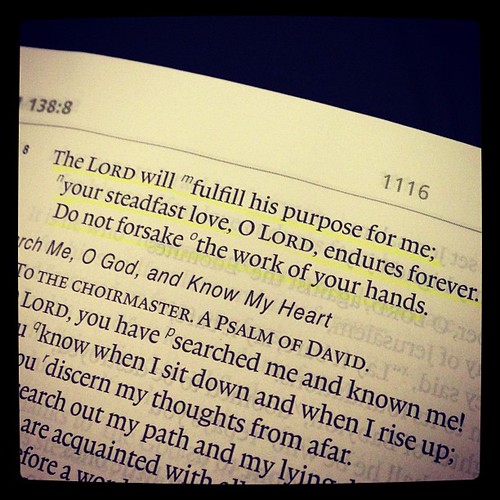
On my birthday, I like to read the Psalm that corresponds with my new age. Well, Psalm 34 is a really good one - a psalm of deliverance, praise, and blessing. God hears and provides refuge. My ESV Study Bible notes this:  
 
There is also a "wisdom" section embedded in the thanksgiving, which is appropriate, because it is the "wise" (i.e. those who live out their trust in God) who have occasion to give such thanks.

Christians like to joke about 33 being a big year, but for me it was externally anticlimactic and internally a struggle. But I have a good feeling about 34. Even if my outward life is exactly the same in a year, I just hope I'll trust God more than I do now. I hope that instead of waiting for "provisions" that might not be intended for me, I'll see God's blessing and deliverance more clearly in the life I have, and live out my trust in Him.

Friday, August 2, 2013

The Redemption of the King


The book of I Samuel has always been one of my favorites in the Bible – I've read it many, many times. I love Hannah the mother of Samuel, and the entire story of David. I recently revisited I Samuel in an attempt to get consistent with personal Bible reading. (It hasn't been very successful, but that's not the point of this post.)

Starting in my early 20s, I felt very convicted by I Samuel 8, the story of Israel demanding a king. I'm not entirely clear on why it was wrong for Israel to want to be ruled by a king instead of prophets/judges (especially since that system wasn't working out so well), but from what I can tell, it involved sinful motivations and pursuit of the wrong things. They told the prophet Samuel that they wanted a king "like all the other nations," and God saw it as a rejection of Himself. So He told Samuel to give them what they wanted, but to warn them of the sacrifices and oppression that a king would bring.

This story always brought to mind my persistent prayers for a husband, and specifically my prayers for a relationship with my ex, who was just a good friend at the time. No one ever drew that correlation for me, but it was very clear in my mind. Since nothing was happening, I felt like I was badgering God for something He might not want to give me, and maybe I was supposed to say "All I need is God" and leave it alone. Even once I was married, the comparison nagged at me. After my divorce, I came upon the story again. I thought about the hard work and suffering of my marriage, a marriage I had already prayed and wept over years before it began. I thought, Yep. That's what I get for "demanding a king." I don't even believe everything that this interpretation implies, and realize that a complex historical story and a normal desire for a spouse are apples and oranges. Yet I continued to feel vaguely guilty anyway. When I arrived at that chapter again last week, I re-read it with some trepidation. But as I continued reading, I suddenly saw something brand new. God ran with what was already in my head and showed me the rest of the story.

Israel wanted a king regardless of the consequences, so God chose Saul to lead them. Saul's rule began well, but it became clear that loving and serving God wasn't a priority in his life. Saul disobeyed God in a big way on several occasions, and when the prophet Samuel called him on it, he tried to backpedal. When he finally acknowledged his sin, it was out of fear and desperation not to lose what he had. In response, God regretted making Saul king, and removed him from the throne.

Samuel grieved deeply for Saul's actions, Saul himself, and his own role in the whole situation (even though he'd tried to honor God throughout). But after he'd mourned for a while, God said to him:

“How long will you grieve over Saul, since I have rejected him from being king over Israel? Fill your horn with oil, and go. 
I will send you to Jesse the Bethlehemite, for I have provided for myself a king among his sons.” 

Even if you're not a religious person, you probably know that this son of Jesse was David, the star of the Old Testament. David was far from perfect. He committed many sins and blunders, and his reign wasn't free of disasters. But he was a man after God's own heart, chosen to bless Israel with his many skills and talents and point them to God in all he did. (He also happened to be charismatic and handsome. ;))

God could have ended the royal line with Saul, or left Saul in power and let things fall apart as punishment for Israel. Instead, He intervened and gave them David. So, within my flawed interpretation of this whole story, maybe He has a David for me too. God might not intend for me to marry again, and if that's the case, my life can still be happy and fruitful. But from now on, when I feel erroneous guilt about the path my life has taken, or am grieving unhealthily over things long past, I'll remind myself of God's abundant grace and mercy even in Plan B situations. I'll remember that I am free. Then I'll pray for a man after God's own heart, fill my horn with oil, and go.

Friday, July 19, 2013

Owning It


Two friends and I are about halfway through reading and discussing Anything by Jennie Allen. If you haven't read it, it's the story of how she and her family arrived at a point of telling God they would do anything for Him, and started "living radically." While I admire her abandonment, I'm so weary of the whole "the American Dream is PURE EVIL, so sell all your worldly goods and move to Africa, or you're not a real Christian" attitude. Going to Africa was her initial idea of "anything," but maybe there's a twist later in the book – I haven't gotten there yet. My point is, countless books and sermons tell us that there's only one way to live a life that counts: full-time ministry, preferably global missions, the more dangerous and sacrificial the better (I call this "looking-for-trouble theology" because seriously, doesn't each day bring enough trouble of its own here in the regular world?).

Thankfully, my pastors regularly refute that message, speaking honor over lives lived out in cubicles, kitchens, hospitals, classrooms, and studios. They reassure us that our different, often menial callings are equally important in the work of redemption. I appreciate this so much. But it's still hard for me to deprogram. I've never felt called to global missions. I've never been much good in the inner city or with youth. There's only one thing that's been in my bones practically since birth, and that's writing. But that's flighty kid stuff, right?

***

My writing class has a conference call/video chat every Saturday. Last week, the discussion questions and topics were about owning your calling as a writer. Our teacher read us a passage about "the virtue trap" – the tendency to put our writing talents on the shelf in the name of selflessness, so they won't interfere with our "real" jobs, so others won't disapprove of our "selfish" pursuits. When we don't make room for our writing or make it a priority, we sell out our creative selves, and in so doing, cease to be whole people.

Well, I was openly weeping over my journal pages by the end of the call. I've dismissed myself as a writer every day of my adult life. It's only been a few years since I mustered up enough confidence to start this blog. Even now, I usually see my more serious posts (let alone anything bigger I might want to write) as a self-indulgent running off at the fingers. Writing things out is the only way I can make sense of life, but I feel guilty about doing it publicly. The internet and bookstores are already glutted with opinions and personal stories. Who needs one more? In recent months, I've felt increasing annoyance at other low-level bloggers who share their posts far and wide, generally acting like their words matter and are worth your attention. They behave like validated writers regardless of how great their writing is or the size of their audience. I mean, how can they own their thoughts so boldly? Don't they know their place, as I know mine? Aren't they afraid of public shaming by trolls or even people they know? Who do they think they are??? Yes… we have located the ugly source of the toxic leak.

The idea that the Holy Spirit is my muse, that God actually wants me to write and smiles on my efforts, that writing is what He put me on earth to do, is almost too much for me to wrap my head around. It seems too easy, but it's not. If I really believed in and owned my calling, it would require consistent work and sacrifice, and maybe eventually financial struggle. It would require me to trust God in new ways, taking chances and trusting Him to bring fruit from my labors. In fact, the more I thought about it, the more a commitment to say yes to writing sounded like Jennie Allen's "anything." It (probably) won't involve orphans or moving into a yurt. But it could be the big, risky work of God in and through my life all the same.

I can't change my heart about this overnight. I don't know how to proceed in a practical sense. But I want to start respecting my writing and seeing it as holy. I want to believe that it has a lasting purpose even if the whole world doesn't see it. I want to let my light shine without fear, even if it's a candle and not a floodlight. I can't wait for permission to be honest and real, because the world will never give it to me – I can only claim it for myself. If I even make progress toward that goal, I think it could change everything.

Tuesday, July 9, 2013

Reach and Release


(The current prompt for my writing class is reach and release. I'm not sure if the following is the direction we were supposed to take, but it's what came out.)

I am a chronic reacher. If I feel a sense of accomplishment in any arena of my life, it's usually fleeting. Rather than be at peace with myself and my place in the world, I inherently struggle to do better and be better, driven by the unrelenting lie that I'm not enough (in any sort of way), but if I work really hard and do all the right things, I could be someday.

Being motivated and engaged with life is desirable to a point, but it's very easy for me to cross into destructive territory. Whenever I let down my guard against my striving tendencies, they take over quickly. I'm in a spiritual valley at the moment, and reaching is a big part of what put me here. Again. Any time I stop actively fighting it, reaching kicks me right down the spiral staircase of insecurity and hopelessness. I feel increasing guilt over being a small, regular person instead of someone who's radically changing the world (forgetting that everyone isn't meant to be a superstar). I decide that the things that are lacking in my life must be my own fault and failure, instead of part of an ultimately good plan. I decide that God is pleased with my friends, but disappointed in me… because of course, reaching seeps into my relationship with God like poison. The voices telling me what I owe God, and how much more He expects of me and my life, drown out the voices of grace. I know I have to do better – but I also know I don't have it in me.

Thankfully, I always collapse in on myself eventually and find grace again. I remember the parable of the talents, and the man who buried his money in the ground because he (wrongly) feared a harsh taskmaster – one who wouldn't tolerate not getting a full return on his investment. I think of the parable of the father who joyfully embraced his lost, filthy, worthless-by-all-accounts son. I remember that no matter what my circumstances, I don't have to earn God's love or worry about losing it. He loves me as I am, where I am. Unlike the rest of the world, He's not expecting me to perform or keep leveling up. He just loves me. And in the moments when I really take that in, I can release my need to achieve, and reach for grace. I can open my hands, because I never had anything in them to begin with.

Thursday, June 20, 2013

All Who Wander

Ocean
 
Source: Andrew at Cuba Gallery. Beautiful work!


Throughout my teen years, I tried on a lot of denominations and schools of Christian thought. (There was a brief period in college when I labeled myself "Catholibapticostal.") While I liked certain aspects of all of them, none felt exactly right to me. There was always something I couldn't get past. But when I was 20 years old, I fell in with a bunch of Presbyterians and knew immediately that I had found my spiritual home. I understood the scope of grace for the first time. My heart and life were changed. In a sacred sense, I fell in love, and I was sick of dating around. I was ready to settle down. I felt so free and alive in my faith, I fully expected to hold to all of these new beliefs till death do us part. My mind would never change again on any of these matters. The end. It's the kind of declaration you can only make when you're 20 years old. My life was just beginning, yet I assumed that my spiritual evolution was complete.

I still attend a Presbyterian church, consider myself Presbyterian, and cherish many of those beliefs. But when it comes to less crucial principles, I don't know what I believe anymore. The collapse of my marriage and the rebuilding of my life has been like an 8.0 earthquake. It couldn't shake the bedrock of my faith, but it caused serious structural damage, if not outright destruction, to most everything else. A lot of those Jenga towers haven't started to lean until recently, years later. I struggle to reconcile certain teachings with my reality and experiences. Sometimes I'm startled and alarmed when I catch myself cheering on viewpoints that I once opposed. It's scary when you suddenly don't recognize yourself.

But I'm starting to think it doesn't have to be scary. I believe in the importance of doctrine, that little things do matter and affect how we live. But I also believe that God is bigger and more mysterious than we can possibly comprehend. Yes, He reveals Himself to us in His Word, but we'd be out of our (limited) minds to think we can ever fully understand Him. It's okay to cross-examine things we've taken for granted, and be open to different ideas. Maybe part of wisdom and maturity is realizing that the older you get, the less you know. The world keeps getting bigger, not smaller. I hope so, because I have a lot fewer concrete answers than I did as a college student.

My impression is that a growing, sometimes questioning faith is healthier than a stagnant, unchanging one. A static faith is not fully alive. I think God can handle our doubts and everything that comes with them, and He'd rather we just be honest with Him. I tell people this all the time, but I don't live like I believe it. It's time to claim the assurance that while I may wander, I am not lost.

Thursday, June 13, 2013

Love Is Worth It


A friend recently ended a long, undefined relationship. Although it was terribly painful, she says she doesn't regret it or consider the relationship a waste, because of how she changed and what she learned through the experience of loving this person. Her words reminded me that I used to feel the same way. Being alone for so long after an intense hurt has made me very defensive of my heart, but God does some of His best work when we open up and risk caring deeply for someone.

Over the ten-year scope of my relationship with my ex-husband, I always sensed that my feelings for him were too profound and persistent to come from me alone; that God had somehow appointed me to love this man. No matter what I did, I couldn't shake my feelings for him, even though he never fully returned them. In the years before we dated (and then late in our marriage), my tenacious love caused me a lot of suffering. But it also drove me to God, forced me to trust Him more, and stretched me in inexpressible ways. It gave me a new understanding of the depth of Jesus' love. It opened my heart and showed me the beauty and value in loving sacrificially, regardless of what you get in return.

After my ex left, I reasonably thought that I must have "heard" wrong from the beginning. If I had been meant to love him, God would have saved our marriage and this wouldn't have happened. No, it must be that I'd fallen in love, hung on like a stubborn mule, and badgered God relentlessly until He, reluctant and sighing, gave me what I wished for. I was a fool reaping the harvest of her foolishness. But eventually, I recognized that I was trying to make sense of the senseless by taking responsibility for someone else's selfish decisions. I realized that even though those years were now a pitiable waste by the world's standards, they were still valuable because of what they had done in me. Even today, I am a deeper, more complete human being because I loved that man. If God did indeed call me to that love, and even if changing me was His only purpose (I don't think it was), it would still be enough.

Inspired by my friend, and this great post about King David and his first wife Michal, I searched the Bible this week for all the direct statements that X loved Y. As an overall picture emerged, I was stunned. With a few exceptions, the Biblical stories of people who loved other people are rife with disaster and tragedy. I'm talking Game of Thrones type stuff, and not just romantic love, either – all four loves are clearly represented. I can't speculate on whether these relationships were poor decisions, "God's will," or what, but I find it interesting that these are the loves God chose to highlight in His Word. It's depressing and encouraging at the same time. To me it shows that a sad ending – or any ending – to a relationship doesn't mean God's hand wasn't on that relationship. (Just look at Hosea, a story that I still connect and wrestle with.) It's also proof that God can use even the messiest, most dysfunctional love to advance His kingdom. Not that we shouldn't use wisdom when bringing people into our lives, or let them walk all over us. But if we get hurt, if we lose everything, there is still hope and purpose to be found.

One of my favorite quotes, which I occasionally mention here, is Goethe's "In all things, it is better to hope than to despair." Well, it follows that it's also better to love than to be afraid to love. As C.S. Lewis famously said: “To love at all is to be vulnerable. Love anything and your heart will be wrung and possibly broken. If you want to make sure of keeping it intact you must give it to no one, not even an animal. Wrap it carefully round with hobbies and little luxuries; avoid all entanglements. Lock it up safe in the casket or coffin of your selfishness. But in that casket, safe, dark, motionless, airless, it will change. It will not be broken; it will become unbreakable, impenetrable, irredeemable.” When you've experienced real loss, it's natural to want to shut your heart away to make sure you'll never experience it again. But in the end, the thought of developing an unbreakable heart is scarier to me than the thought of reliving the pain. I want to be open even if it hurts. You can't grow when you live guarded and afraid. Love, any kind of love, is always worth it.


(I have more thoughts on love, from another angle, which I might post about next week.)

Thursday, June 6, 2013

Neediness


I hate needing people.

I've spent a lot of my adult life actively cultivating toughness and independence. It hasn't come naturally. There's nothing wrong with seeking to be stronger and more capable, but I think I've crossed into a kind of unhealthy place. A place where I often feel like a failure if I have to call someone for help or prayer, or if I'm unable to, say, pick up and move a 50-inch TV. A place where my wrath is unleashed if anyone (especially a man) implies that I'm weak or can't handle myself. An island where I try to heal my hurts by telling myself I don't need anyone, people are undependable anyway, the only person I can always count on to have my back is me.

My parents, especially my dad, are the only people with totally free passage over my moat of self-reliance. When I was first navigating life and homeownership by myself, I had to let them help me. I couldn't do it all alone. Years later, that's still true more often than I like. But even though I don't think they should have to help their 33-year-old daughter maintain her lawn mower, or come over to let her cable guy in, I can handle it because I know that my neediness will never drive them away. They're not keeping accounts. They will still love and accept me no matter what. I don't feel that security with anyone outside my immediate family. That's not the fault of my close friends, who are steadfast, amazing, and have never given me reason to doubt them. It's just my own personal damage. I don't want to be a burden to anyone, making their lives difficult or giving them a reason to ditch me. And when it comes to church community, that's compounded by the vulnerability involved in talking about deeper needs. Handing people an opportunity to mock or shrug off or totally misunderstand your neediness is a scary, scary thing.

I generally don't have a problem accepting my dependence on God. I'm constantly aware that I'm dependent on Him for everything, including the air I breathe. But my feelings about needing other people do affect how I feel about my need of God. I constantly fight the (false) impression that He's exasperated with me, wondering when I'll ever get a grip and stop pestering Him all the time. I feel apologetic when I get too petition-y in prayer. I get annoyed that with every year, I feel more dependent on Him, not less, and shouldn't I have made progress by now? Last night I flipped through old sermon notes for encouragement and inspiration. Again and again, over more than a year's worth of sermons, I saw this theme reflected back at me:


God wants us to live in childlike dependence on Him.
We can't appreciate God's strength and power without knowing our own weakness.
Our self-image must be deconstructed before faith can become real.
The goal is not self-sufficiency, but Christ-sufficiency.
Needing God is not remedial Christianity, but mature Christianity.
Self-reliance is the enemy of our souls.
We were not created for autonomy.


The thing is, I like to be needed. I like to be there for others in practical ways. It gives me a chance to show that I care, and be part of God's work in their lives. It also helps me feel like my life means something. I fully understand the value of interdependence on the giving end, but have a hard time comprehending it on the receiving end. However, I recently had the revelation that spiritually healthy people are not afraid to be needed in a healthy way. If someone expects a relationship, even a casual friendship, to be 100% about her and her needs, something is wrong. If someone tears you down or cuts you out of his life for being too needy – in a normal way, not needy to a codependent, vampirish degree – the problem is with him, not you. That doesn't totally take away the pain or humiliation, but it helps.

Neediness is messy and unpleasant and uncomfortable. But it's an unavoidable part of being a human. Some people are just better at hiding or suppressing it than others.

Friday, March 29, 2013

Good Friday


We Christians are supposed to spend Good Friday dwelling on how much Jesus suffered to cleanse us from our sins. Yes, His suffering was immeasurable, but we often lose sight of why He went through it – "for the joy set before Him." Not purely for suffering's sake, or to grudgingly make a way for us hopelessly sinful humans. It was His joy to mend the gap and reconcile us to His Father. Jesus had motives. His happiness is tied up in ours. He wasn't robotically going through the motions of His difficult purpose on earth – He gladly persevered because the fruits of His labor were guaranteed.

This has been the winter of my discontent. The "sufferings" in my life are pretty frivolous compared to what millions of people currently deal with, but they are still real, slowly wearing me down as all sufferings do. Usually, if I have assurance of some eventual purpose or payoff (sometimes even if I'm not the beneficiary of it), I can endure things for a long time. What's finally sent me off the rails and into the swamp of despair is a loss of purpose. For a variety of reasons, my "thorns" don't seem to have any point or positive effect anymore. I fear that they'll just keep weakening me until I'm useless to God, virtually laying on the floor crying out to Him all the time instead of out serving and accomplishing for Him, and my life will count for nothing. The end.

No one can stand up for long under that kind of hopelessness, and I don't think we're meant to, because even Jesus didn't. Even Jesus, the only perfectly holy person who ever lived, didn't suffer in a vacuum. He had His eyes on the prize, and God infused meaning into everything He did. That gives me a renewed confidence in God's sovereignty over our circumstances. Over the last few years, I've often felt doomed in certain ways because our world is just so messed up. I've pictured God shrugging sympathetically and saying "Sorry, kiddo. Fallen world." But on this Good Friday, I feel reassured that our suffering is not some crazy random happenstance, just the byproduct of a fallen world. Even when there's no evidence, God still has a purpose and will be glorified in all of it. Jesus needed motivation to endure, and God knows that we do too. Jesus' motives on the cross – love for us, love for His Father – should be ours too. As my pastor said last night at Maundy Thursday service, "If these joys are good enough for Jesus, they are good enough for you."

We can rest and know that no matter what's happening or not happening in our lives, if we are God's, He loves us and is pleased with us. He loves us so much that He sent His Son to die for our sins. And in the words of a famous preacher whose name I can't remember – SUNDAY'S COMING.

Thursday, March 14, 2013

Abundance


Even though I'm a Christian, my perspective on life can veer shockingly karma-ward. It's so subtle that I didn't start noticing it until a few months ago. Left to my own devices, I believe in a balance to the universe, a mystical, sacrificial bargaining philosophy (well expressed in several Florence + The Machine songs). I've had unbidden thoughts like, Well, if only I or [person I love] could have [good thing she has that I don't], I'm glad it was her. Like there are limits and no good can come to anyone without someone else paying the piper.

This belief might romanticize our sufferings, or help us feel like we have some control over them. But it's completely unbiblical.

I think I know where some of it comes from, though. One of the most brilliant parts of Daring Greatly (sorry I'm not sorry for still talking about this book) is Brene Brown's observation that we live in a culture of scarcity. We have a gut instinct that there's not enough of anything – food, land, love, blessings – to go around, so we scrape and claw for whatever we can get, and once we have it, we defend it ferociously. It affects every aspect of our being. It's part of why we live by checks and balances and have such a hard time understanding grace.

The fact is, we serve a God of abundance, not scarcity. His resources are limitless, and Jesus paid for everything – our sins and everything else – on the cross. He balanced the books forever. None of us deserve blessings, but they're all free and God can pour them out on us as much as He chooses. While writing this, I did a search for "abundant" on Bible Gateway and got 46 results, most of them in connection with God's provision for His people. I don't believe in prosperity theology, but I could use more reminders that God's default setting is abundance (non-materially speaking). His goodness, peace, joy, and love are available to me abundantly. In the meantime, if He denies me good things, He's not just doing it for fun.

Throughout her great book The Allure of Hope, Jan Meyers uses the allegory of a person sitting down to a glorious meal of all her favorite things, prepared by a joyful, talented chef. The person is filled with happy anticipation, but just before the meal is served, she's suddenly escorted down a hall and into a dark, cold alley. The door shuts behind her, and she's left alone. She pounds on the door, but no one comes to let her back in. She tries to make sense of what's happened, convinced that she must have imagined the kindness and good intentions of the chef. It's an unusual allegory, but the picture it paints is very powerful (to me, anyway) and provides a lot of angles for reflection. Today it reminds me that even if I feel like I'm in the alley at the moment and no one is coming to the door, the feast is still inside and the Chef is still in charge. He's not presiding over an empty table, but one full of good things. And whenever the door opens, even though my hands are empty, I can partake with joy without washing any dishes.

Tuesday, February 26, 2013

Seasons of Life


A friend recently told me about a women's retreat workshop she attended, Seasons of Life. The speaker, an older woman, just shared her story and how God worked in the different stages of her life, dropping threads and later picking them up again. After the typical life chapters of young wifehood and then motherhood, she went back to college for a doctorate and found a fulfilling career later in life! My friend and I were both encouraged by the reminder that all of our lives have seasons, even if they're more subtle for some of us. It's sometimes difficult for me to grasp this as a single, childless woman with no outside forces acting upon me. For parents, the seasonality of life is very present because children grow up more every day. They create an environment of constant change and adaptation, and a path for your life to follow. Certain careers or situations can have the same effect. But when you're living the same routines and going to the same job for years upon years, no one coming into your life to shake it up, no one further ahead to show you the way, it starts to feel permanent. As well as I know the importance of perspective – that nothing, good or bad, is forever – lately I feel like, Well, this is it. For better or worse, this is my life. For the next fifty years or however long God deems my life to be.

I have an innate need for security and spurn change for change's sake, but the suggestion that this is it has been depressing. For maybe the first time, I'm kind of itching for a change – a positive one, I'm quick to point out to God and the universe. Not, like, a death or layoff or a move to another continent. Not necessarily a huge change, because I'm happy with many things in my life. Just something new and exciting. Some advancement. In the past month or so, I've briefly considered getting a roommate, going back to school for an MFA, and moving into the city to live closer to my friends, among other things. Borderline crazy risks by my standards. None of those things are going to happen (at least anytime soon), but my desire to make these moves even briefly was a neon sign that something is really lacking in my life. I can't do much to bring about the things I really want, so I'm casting around for something I can do. I just feel stuck.

My Sunday school class is studying Elijah right now, and last week's lesson was about Elijah at the brook of Cherith. How it didn't make sense for God, who had just called Elijah to do big things, to send him into the desert where he would be isolated and totally dependent on God for his survival. Personally, I feel like I've been sitting at the brook of Cherith for a long time, slowly watching it dry up, and I've really had enough of the place. I increasingly wonder whether God has forgotten that I'm out here, if I should just build a house and settle in. God has good reasons for desert times of waiting, and I don't want to waste them, but I need some reassurance that the waiting will eventually end and be fruitful and worth it. I wish I was holy enough not to need that, but there you go.

Thankfully, I have found some comfort in Isaiah 49. Confession: sometimes I have trouble taking the promises of the Bible to heart. I'll think, This verse probably applies only to a specific group of Israelites from thousands of years ago, and not to me at all. But when I read Isaiah 49 this week, I knew God was speaking to me.

Can a woman forget her nursing child,
that she should have no compassion on the son of her womb?
Even these may forget, yet I will not forget you.
Behold, I have engraved you on the palms of my hands;
your walls are continually before me.

I was bemused by the "walls" reference, but according to my study Bible, it refers to the walls of Jerusalem that were demolished during the siege of the city by the Babylonians… and God's intention to restore them. To think that God not only hasn't forgotten about the rubble of my torn-down walls, but also remembers them constantly and still has plans to rebuild… well, that helps. It helps a lot.

Tuesday, January 29, 2013

Downloading Holiness


My Sunday School class is currently studying wisdom. I've long agreed with Solomon about the value of wisdom, and been thankful for the Bible promise that God will give it to us if we ask for it (James 1:5). (There aren't many guarantees like that in the Bible!) I've always imagined God essentially waving a wand over my head, imparting the wisdom I need for each situation. But that's not how it works. Just like all other growth in the Christian life, gaining wisdom is a process, and that fact continues to confound and frustrate me. It also awes me, because it implies that God's ultimate goal for His people isn’t insta-perfection, or blind robotic obedience. If that were the case, He could give us all the wisdom and sanctification we need in one swoop. My default assumption is that God is primarily looking for maximum performance and efficiency in my life. But if He expects me to walk a straight line from A to B, why has He led me down a long, winding side road where I can only see the path directly in front of me? If He expects me to correctly interpret every word of the Bible, why won't He just download the knowledge into my brain, like Trinity in The Matrix?


how I wish life worked

When these frustrations start to spread and permeate my life, I feel like God is working against me, even mocking me. The only explanation is that the detours and struggles are supposed to be there. They're part of a process that makes us more whole and more human. That doesn't make sense if you believe in a God who's only concerned with results. But wisdom, knowledge, and "correct" living aren't everything. God cares more about our hearts and about us as individuals. He wants us to learn and grow in relationship with Him, and that takes time and work.

Years ago, during my divorce, I knew I had to go through all the grief and junk instead of avoiding or escaping it. I even posted a Ruth Graham passage about that, which I still think of often. But I didn't realize until recently that the principle applies as much to regular life as to a crisis. Sometimes we feel stuck in our day-to-day circumstances and become frantic to "get ourselves out" (and our culture encourages that attitude). But if your healthy efforts toward change are fruitless, there might be a reason why. My life isn't what I'd hoped it would be by this point, but it helps to think that God is behind that and has a purpose for it, instead of being disappointed in me for not making things happen. I'm trying to regain the open and trusting attitude I used to have – asking God to show me what He wants to teach me in this place, instead of constantly looking for a way out. Taking my discouragement and frustration to Him instead of trying to bury it under mustered-up thankfulness. God isn't worried about how slow my progress is or whether I fit the mold of the perfect Christian woman. He wants me to know Him more than He wants a trophy daughter. I have to keep reminding myself of that.

Thursday, December 13, 2012

Mary Mary


Every Advent, I connect with the song "Breath of Heaven," about Mary. (It's uncool of me to admit my love for an Amy Grant song, but if you thought I was cool, you didn't know me very well.) Mary is so inspiring. She could have been angry about the monumental task God gave her, which ruined her reputation and could have cost her everything, even her life. She could have given in to fear. She could have insisted that she was inadequate to be the mother of the Messiah, and then kept dwelling on her own inadequacy. But she accepted God's plan for her, not with trembling, but with boldness. She had full confidence in God's goodness and His ability to strengthen and provide for her.

If Mary, a nobody teenage girl in a society that regarded women as property, could bravely embrace the most important role in the history of mankind, I should be able to embrace the MUCH less demanding life path I've been handed. He who is mighty has done great things for me, too. I may not have a clue what He's doing with my life, but Mary had even less of a clue, and she still trusted, and her life glorified God mightily. May I grow to have the same open, surrendered heart.

Friday, October 26, 2012

Confessions of a Former Quiet Timer

verse of the month
The extent of this month's personal study

Throughout most of my 20's, I had a consistent, classic "quiet time" every day. Every weekday morning, I got up, read a chapter of the Bible, and wrote in my prayer journal. I had comprehensive prayer request lists and even prayed about specific topics on certain days of the week (I remember that Friday was for family, and Wednesday was to pray for spouses for my unmarried friends, and then for their marriages as they all got married). It was rewarding, but also something of a false security for me – even though I was a failure in other ways, at least I had this much-hyped aspect of the Christian life wrapped up. Despite not being a morning person AT ALL, I even did it in the morning, because that's the holiest time of day to commune with God, right? :P

When I was 27, my ex-husband and I bought a house in the suburbs. I no longer lived down the street from my workplace and had to get up earlier. I tried to continue with my morning devotions, but they quickly dwindled to a few days a week. Eventually, after repeatedly staring drowsily at the same sentence for the entire time, I gave up. The old ways were not going to work anymore. I started reading and praying at night, inconsistently, but was never as focused or mindful about it again.

Lately I'm as far from that quiet time piety as I've ever been, and it worries me. Although I'm even more interested in the Bible now, I'm mostly getting it through other avenues – listening to sermons online, reading topical books, going to church and small groups. For whatever reason, it's become really difficult for me to sit down alone and study the way I used to. I've already done the Bible in a Year program and am not in the mood to do it again, and I can't just keep rereading Isaiah, the Psalms and the New Testament. A couple of months ago I bought a good commentary on Philippians (one of my favorites), thinking an in-depth study of one (easy) book would be interesting. Quality over quantity. But the discussion questions for each chapter take me forever to answer, and I don't even feel like I'm retaining much. So I'm not up to date with that either. I've heard these same laments from many mom friends, but I don't even have the acceptable distraction of a child. My distractions are other books, or my cats, or Friends reruns that I've seen ten times. Meanwhile, I hear things like, "Reading God's Word regularly is essential to knowing Him," and even "Your quiet time is as important as plans you make with friends, and if you don't 'show up,' you are standing Jesus up." And I love God and want to know Him more, but at this time I can't get motivated to habitually seek Him in this specific way. Sometimes I do genuinely want to, but it doesn't happen on a schedule.

My individual prayer life doesn't fall within measurable channels anymore either. I've become a person who prays for people and situations as they come to mind, and thanks God for things as they happen. I keep up a sort of casual conversation with Him throughout my day. But if I sit down alone with a list and try to grasp at prayer and do Real Spiritual Business, it runs through my hands like sand. I can't concentrate or find the right words. Since my difficult times a few years ago, I've noticed that I pray on more of a gut level. Often when I feel passionate about something in prayer, I can't even express my thoughts, so I send up a mostly wordless emotion and trust that the Holy Spirit can translate it. Is that lazy? Does it "count" for anything? I don't know. Paul Miller's book A Praying Life made me feel better about this, but it's hard to shake off the feeling that prayer ought to look a certain way.

Believe it or not, this is only the tip of my iceberg of angst on the subject. I don't have a decisive conclusion either. I'm mainly sharing so if others are struggling with this, they'll know they're not alone. I've given up on finding a quick fix to get me "back on track," and am actually wondering if this is even something that needs to be fixed. Maybe this is a part of spiritual growth, and it's okay to have an open mind. Maybe it's another area where I need to start acting like I believe in grace, toward myself as well as toward others, instead of just talking about it.

Thursday, October 4, 2012

Free Parking


This week I've listened to a couple of sermons that have blown my mind. You can listen here and here. The pastor, Jean Larroux, was an assistant pastor at my church YEARS ago. I used to go to all his Bible studies (and I wasn't even attending there at the time). Now he has his own church in Alabama, and I sometimes listen to his sermons online while I work. In this series he's addressing "parking place theology" - the false belief that obedience should equal blessing. This is rooted in a false belief that, even as Christians, in Christ, we still have to work to appease God or put a smile on His face – e.g., we do a good deed, and God rewards us with a good parking place at Target. When we believe this, our faith becomes no different from karma, or tribal people making sacrifices to the rain god. Wow.

When I really started to think about this topic, I was STUNNED by all the ways it manifests in my life. As Jean says, it's easier, for some of us, in theory, to live by the Law than by grace. I am a born Good Girl and rule-follower. I like a how-to. I like a list of concrete steps which, if followed correctly, will yield a good, predictable result and a gold star. I can endure a lot of difficult things if I know there will be some reward or payoff. But we're not promised a payoff in this life. Many of us have sought and struggled to honor God and do the right thing in the midst of tragic or unjust circumstances, and bad things happened anyway. Sometimes they kept on happening. Or we just didn't get the rewards we were expecting. I have a lot of personal experience with this. I do believe that God, like any Father, is pleased when we genuinely want to please Him, but we shouldn't do so to earn His love or anticipate some compensation for those lame efforts.

I'm muddled about how redemption factors into this whole deal. Where's the line between hoping for God to redeem a wrong or loss (which He's proven throughout Scripture and history that He loves to do), and looking for our good parking place? I don't know. I will never have all the answers. But these messages gave me a start.